Friday, December 16, 2022

Power and Shit: Sanitation, Status and Segregation

Sanitation infrastructure and its labour regimes are a key vector through which division, difference and power are negotiated and made visible. Access to WASH or lack thereof has a history of widening and creating divisions in African societies. This is famously seen in South Africa, where the 1903 Land act forcibly relocated Black people, pushing them into informal housing (townships) away from the old town(Barnes, 2018). Water infrastructure was absent in these townships, with very limited supply and no waste management, whereas the white communities had the most sophisticated sanitation infrastructure on the continent. This was a situation termed “water apartheid”(Jegede,2021).. Despite legislative reforms and new investments in recent years, the legacy of the apartheid period remains, 20% of black South Africans don't have access to improved sanitation compared to just 0.2% of white people.


 Additionally, discourses around sanitation were used by colonial administrators to justify the racist segregationist policies in South Africa, as argued in Maynard Swanson's(1977) seminal paper with a process he termed “sanitation syndrome”, where black people were viewed as harbingers of disease that should be kept separate. Figure 1 shows the stark inequalities in South Africa, illustrated in the built environment, a legacy of sanitation syndrome.


 Figure 1: Majority white neighbourhood Primrose (left) and majority black township Makause(right) Johannesburg: source 


In Mombasa, Kenya the city sewer system and sanitation infrastructure was well developed by the 1960s, but was restricted to European enclaves in the city and industrial facilities: access to clean water and sewage systems “was skewed towards the master and money”(Kithiia, 2020). The pre-independence racist sanitation infrastructure division in Mombasa transitioned to a classist infrastructure whereby Mombasa’s wealthy elite have taken up the residences of the old colonists and the city’s working class lived in informal residences without sanitation or water access (Willis, 1995). Despite reforms in the 2000s, the poor residents of the city still lack access. Given the way poor sanitation causes disease and holds women back, inequitable sanitation is debilitating for social mobility, exacerbating and solidifying social divides(Kithiia, 2020). This is a repeated story in many African cities, Africa’s urban rich are 227 percent more likely to have access to improved sanitation vs the urban poor(Armah.et al, 2018) .


Researching for my last post on taboos led me to discover the ethnic/caste divisions in Madagascar and how taboos around the management of human waste were central to the demarcation of a rigid caste hierarchy on the island. The Sakalava ethnic group see waste management occupations as polluted and taboo, jobs that are beneath them and should be left to the lowest of society. Thus groups like the Tandroy, (who predominantly do waste management) are stigmatised and made to feel inferior, the association of their jobs with faeces is deemed impure. Consequently, it's taboo for Sakalava to eat or associate with Tandroy people(Rijke-Epstein, 2019)


The stigmatisation of those communities doing sanitation is multi-generational, creating a poverty trap that critically reduces social mobility. This is an acute issue of social exclusion, with the labour regimes of sanitation acting as a vehicle for regressive conceptions of status and difference between groups(Rijke-Epstein, 2019). The crystallisation of social hierarchy and difference around waste and sanitation is not exclusive to Madagascar but is seen in several different societies in Africa, including Mali, Somalia and the Amhara in Ethiopia(Freeman,2003)


Monday, December 5, 2022

Shame, Secrecy and Sanitation- A note on taboos.

The gendered nature of sanitation described in my last post can not be fully addressed without recognising the power of taboos. In general sanitation issues are not simply infrastructural but relate to the universe of social norms and customs that govern people's behaviour(Akpabio, 2014). This blogs sees how cultural norms and taboos influence sanitation practice rendering behaviours as moral or immoral and why this should be acknowledged when pursuing successful/sustainable sanitation projects In many communities the taboo surrounding menstruation means it is rarely discussed or publicly acknowledged(Aidara and Mbaye, 2020), resulting in a lack of awareness/understanding of the challenges faced by women and girls and leading to negative sanitation outcomes(Sommer, 2013). For example, a study of rural schools in Ghana found a culture “of secrecy driven by fears and avoidance of social ridicule and shaming”(Rheinlander et al., 2017) meaning girls couldn't talk about menstruation related problems. All waste bins were in public spaces with no place for girls to privately dispose of used pads(no bins in the school toilet) this means open garbage piles were used and bushy outdoor areas aggravating sanitation problems and the potential spread of diseases. Given the shame associated with menstruation, those that used reusable pads/cloths often hide them in unhygienic areas, which further exposes girls to infection(Anaba, 2022)

                                       Photo of The outskirts of Tamatave, Madagascar: source 


In Tamatave, Eastern Madagascar, there is a taboo against toilets. Taboos in Madagascar are called “fady” and are more than just cultural norms but the symbolic materialisation of deep seated beliefs. Communities there view digging toilets and depositing faeces underground as a grave insult to ancestors (Albuquerque, 2019), so when a swath of toilets were built by NGOs in 1999 after a cholera epidemic, they were left unused as people continued to practise open defecation. Clearly, not recognizing the cultural context around WASH seriously undermines the success of any initiatives(Rijke-Epstein, 2019)

The Community Led Total Sanitation approach (CLTS)has proved a successful way of dealing with this kind of problem(Metha and Movik, 2011, p.271). With participatory techniques, it aims to force communities to see the linkages between open defecation and disease, and "trigger" them to change their behaviour. Frère St Gabriel, a NGO went to Tamtave, they went to the villagers “and offered them water with excrement in it to drink. When they refuse, they take them to the river and show them that this is what they drink every day.” Soon after the community started using toilets. 

Sometimes, local sanitation practices and taboos held by certain communities can actually aid the success of CLTS projects (Zakiya, 2014). In Kilifi,Kenya it is a profound taboo for a father in law's faeces to mix with those of his daughter-in-law, with strictly enforced gender segregation at open sanitation sites(Bwire, 2011). The Plan Kenya NGO took community leaders on walks in the village showing how not only was their food being contaminated by their faeces but that the nature of open defecation meant that the faeces of fathers-in-law were freely mixing with those of daughters in law. This triggered the community to construct toilets of its own accord and now Kilifi has got one of the lowest open defecation rates in Kenya.

Thursday, November 17, 2022

Sanitation and gender


I found myself losing concentration in the geography common room and ended up going through the haphazard collection of forgotten dissertations, journals and books that fill the shelves. Leading on from my last blog, I tried to find work by an African academic, and I came upon a book by A.Kalu, concerning narratives of women and development in Africa. It argues the status of women in much of Africa is key to understanding development issues. When considering sanitation this is especially true. I found studies showing- most of the unpaid daily tasks around sanitation and water are left to women, see figure 1, with harsh implications. In one study of 15 African countries, all had women and girls as the primary water collectors(Graham et al.,2016). It is mostly women who are responsible not just for drawing water from the well but for transportation, storage and cleaning public and private toilet facilities.(Caruso et al.,2022)

2/3rds of the population in Africa must leave their home to get water. It's women and children who have to walk to the water with consequences for their health in far-reaching ways including Neck pain, spinal injury, and even spontaneous miscarriages from heavy workloads.


Figure 1 who fetches water by region :Source: United Nations, 2015. The World's Women 2015: Trends and Statistics. New York: United Nations, Department of Economic and Social Affairs, Statistics Division. Sales No. E.15.XVII.8, Statistical Annex.

Having to carry the water puts limits on the quantity available every day. This affects women most since they have have greater need for water sanitation services during pregnancy and because of their major role as carers for infants and the elderly. Moreover, with access to sanitation limited, women and girls have difficulty managing their menstruation. Poor menstrual hygiene management along with dangers to physical health has severe psychosocial impacts(Ray,2016). It affects education too, in rural Africa, there are poor attendance and high dropout rates for girls after puberty which can be partly linked to the fact 40% of schools there don’t have basic sanitation(Sommer,2015).


Source: world bank

Poor sanitation services also make women more vulnerable to sexual violence. Kayser's 2019 paper looks at refugee camps in Kenya, Ethiopia, and Guinea exposing a crisis of physical and sexual harassment. In the camps women either openly defecate or travel long distances to toilets. There, trauma from wars and collapsed social structures converge with inadequate sanitation facilitates creating epidemics of sexual violence that severely restrict freedom and opportunities for women(Miller,2017).

Clearly, inadequate sanitation is a women's issue and they are affected most by it. Thus, women must be included in water and sanitation decision-making, Malawi set up local water management committees in the 1980s and it was only when project leaders replaced men with women to head the committees did they start to be productive. Women were the ones using and dealing with water supplies day-to-day, they know what is needed when it comes to community water management.


Wednesday, November 2, 2022

Water and Sanitation in Africa, Introduction and Toilet Tech


“The hospitals refused to take in new patients, as they were already too full, even the verandas of the hospitals were filled with people. In some cases people burnt the dead with all their belongings, as they were afraid of the disease spreading” - recalled Father Joseph on Madagascar's Cholera epidemic


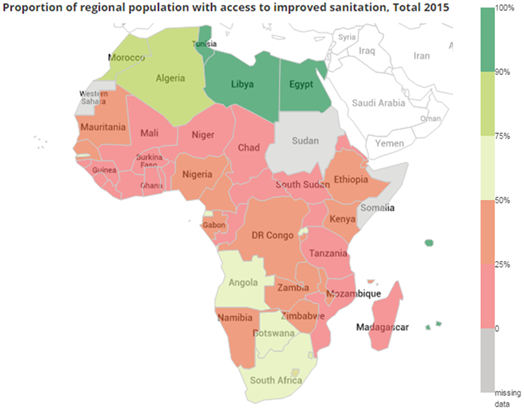
Cholera outbreaks like the one described above are facilitated by Inadequate sanitation. I chose to write about sanitation because it is fundamental to a healthy society, underpinning development(Tseole et al., 2022). Inadequate sanitation causes 115 deaths per hour in Africa, It is the main contributor to the crisis of diarrheal diseases- the leading factor in child mortality globally(Boschi-Pinto et al., 2006). 150,000 children die every year from such diseases in Nigeria alone(Jiwok et al., 2021). Africa has a sanitation crisis, a minority of people have access to adequate sanitation.


What is it? Sanitation pertains to those public health conditions concerning safe drinking water and the disposal of sewage. Good sanitation ensures a separation between human waste and water and food sources without which bacteria and viruses run rampant. There should be blocks to any faecal-oral route, see figure 1. Clearly, The importance of access to water, sanitation, and hygiene (WASH) cannot be underestimated. 


Figure 1: Fecal-oral transmission pathway. Based on Wagner & Lanoix, 1958


Figure 2: the percentage of people with access to improved sanitation, source


 Wainaina's scathingly satirical piece reminds us of the damaging narratives so common in western writing on Africa(Wainaina, 2005). Narratives that are rooted in neo-colonial imaginaries of the continent where white saviourism is predominant, portraying the continent in perpetual need for western intervention. In this blog, I will attempt to be cognizant of this neo-colonial perspective so common when looking at issues in Africa and utilise the work of African scholars.


Toilet tech 
Open defecation is the primary driver of sanitation related disease, toilets are key to separating the lived environment from faecal waste


Pit latrines reign supreme! or do they? They are a cheap and basic form of toilet, effectively an open hole in the ground. They can be vectors for dangerous flies called Chrysomya putoria-  the African latrine blowfly, which spread disease(Lindsay. et al, 2013), to avoid that requires building a special ventilated improved pit(VIP) latrine that prevents the flies entering and breeding.  Western style flushing toilets are often inappropriate, they use vast amounts of water and don't utilise faecal matter that could be productive. EcoSan toilets are the opposite, see Figure 3, the goal is to return excreta to the soil when its decomposed and safe, the nutrient rich excreta can improve crop productivity(Wirbelauer et. al, 2003). Maintaining that system can be too expensive for the rural poor in the long term, subsidies are likely necessary(ibid). These are inappropriate for the urban poor who don't have fields to use the excreta on. 

Figure 3, the operation of an EcoSan toilet: source 


Africapolis: Sanitation, urbanisation and blog conclusions

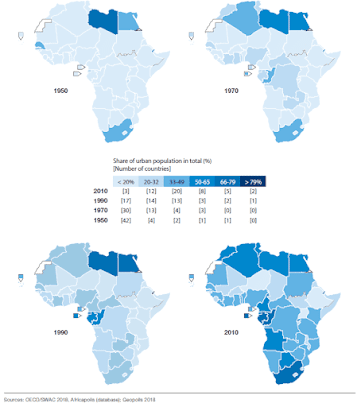
Throughout this blog, I have looked at several African cities including Dar es Salaam, Tamtave and Mombasa. All these places are witness to ...